
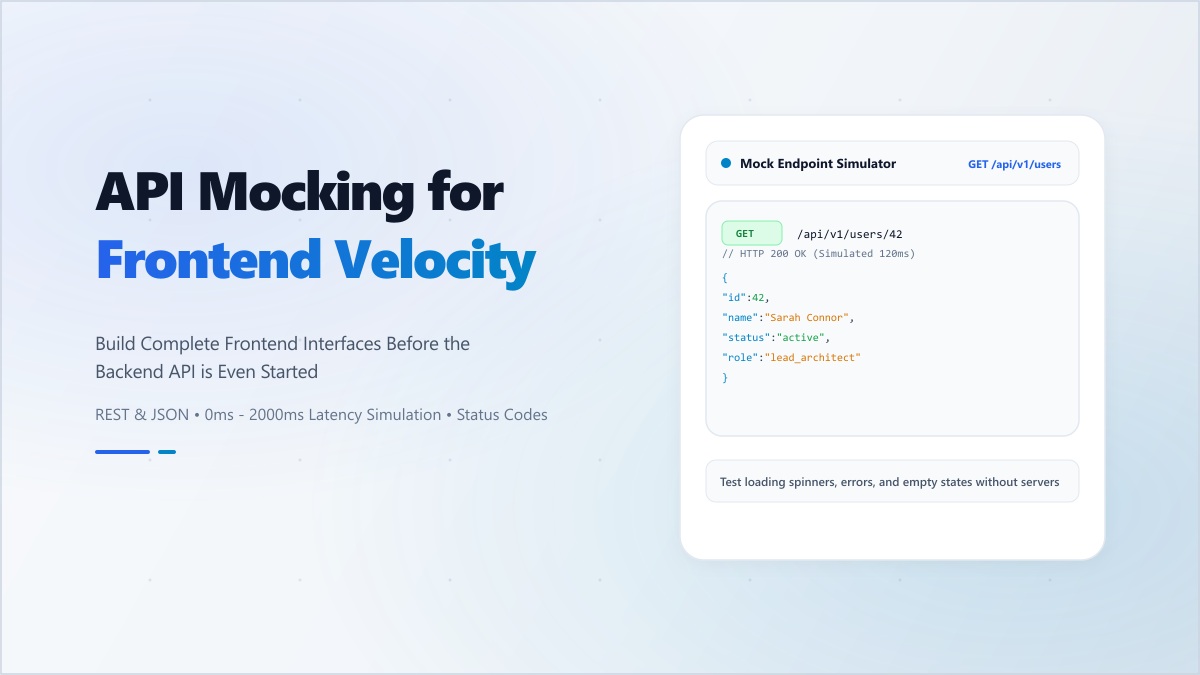
Unblocking Frontend Work When Backend Endpoints Aren't Ready
Waiting on unfinished backend migrations shouldn't stall UI engineering. When frontend and backend engineers agree on a JSON response shape on day one, frontend work can proceed immediately against realistic generated payloads — complete with pagination metadata, nullable fields, latency simulation, and HTTP 422/500 error states.
Once the real endpoints go live, swapping the base URL takes minutes instead of days of last-minute integration fixes.
The Benefits of Contract-First Mocking
- Parallel Development: Frontend and backend teams work simultaneously against the same schema contract.
- Edge-Case Simulation: Test how your UI reacts to slow 3G network latency, empty data arrays, server 500 errors, and rate limits without breaking staging databases.
- Zero Test Flakiness: UI unit and integration tests run predictably against mocked payloads without external network dependencies.
Developer Productivity
Generate Mock REST Endpoints & Fake Data
Design realistic JSON schemas, simulate network latency, and export production-ready mock responses instantly.
How to Structure Realistic Mock Payloads
Effective mocks should avoid uniform lorem-ipsum values. Ensure your mock data generator injects realistic edge cases:
- Varying string lengths (e.g. short names vs. 60-character German or South Indian names).
- Realistic boundary numbers (e.g. 0 balance, decimal floating points, negative values).
- Nullable fields to test fallback UI components and skeleton loaders.