
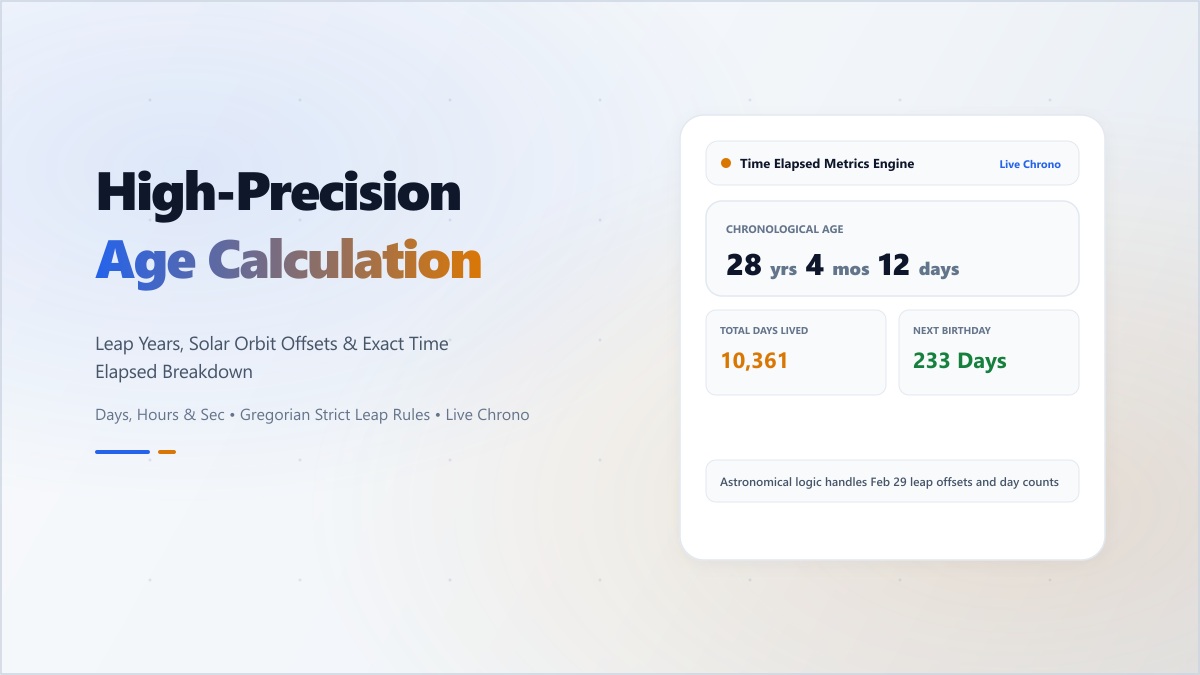
Why Naive Day-Count Division Gets Cutoff Ages Wrong
Dividing total elapsed days by 365.25 works as a rough estimate, but fails on official civil-service, school-admission, and insurance eligibility cutoffs. Someone born on March 1, 1996 reaches 30 years, 0 months, and 0 days on March 1, 2026 — yet dividing elapsed days by 365 incorrectly flags them as several days past 30 because eight leap days occurred in between.
True chronological age calculation subtracts calendar years, months, and days sequentially, borrowing the exact day count (28, 29, 30, or 31) of the preceding month rather than assuming a flat 30-day month.
The Traps of Calendar Arithmetic
Simple age calculations often fail because Gregorian calendar units have variable lengths:
- Months vary between 28, 29, 30, and 31 days.
- Leap years occur in years divisible by 4, except for century years not divisible by 400 (e.g., 2000 was a leap year, but 1900 was not).
- Subtracting dates requires borrowing days from the specific preceding month, not an arbitrary 30-day average.
Calculate Exact Age Down to the Hour
Get exact years, months, days, total weeks, hours lived, and countdown to your next birthday instantly.
Beyond Years: Chronological Life Metrics
Precise age calculation reveals fascinating life milestones: a person aged 30 has lived approximately 10,957 days, over 263,000 hours, and taken roughly 330 million breaths.