Encoding is Not Encryption: The Developer's Reality Check
A common misconception among junior developers and tech enthusiasts is that encoding (like Base64) is a form of security or encryption. It is not. Encoding is simply a method of representing data in a different format to ensure it survives transmission across different protocols or systems that might not handle binary data well.
In the modern web, you are surrounded by encoded strings. Understanding how to decode, inspect, and troubleshoot these formats is an essential skill for any web developer, security researcher, or systems administrator.
The 'Big Three' of Web Encoding
To master the web, you must master these three fundamental formats:
- Base64: Primarily used to embed binary data—like small images or font files—directly into text-based formats like JSON, CSS, or HTML. It's the 'envelope' for binary content.
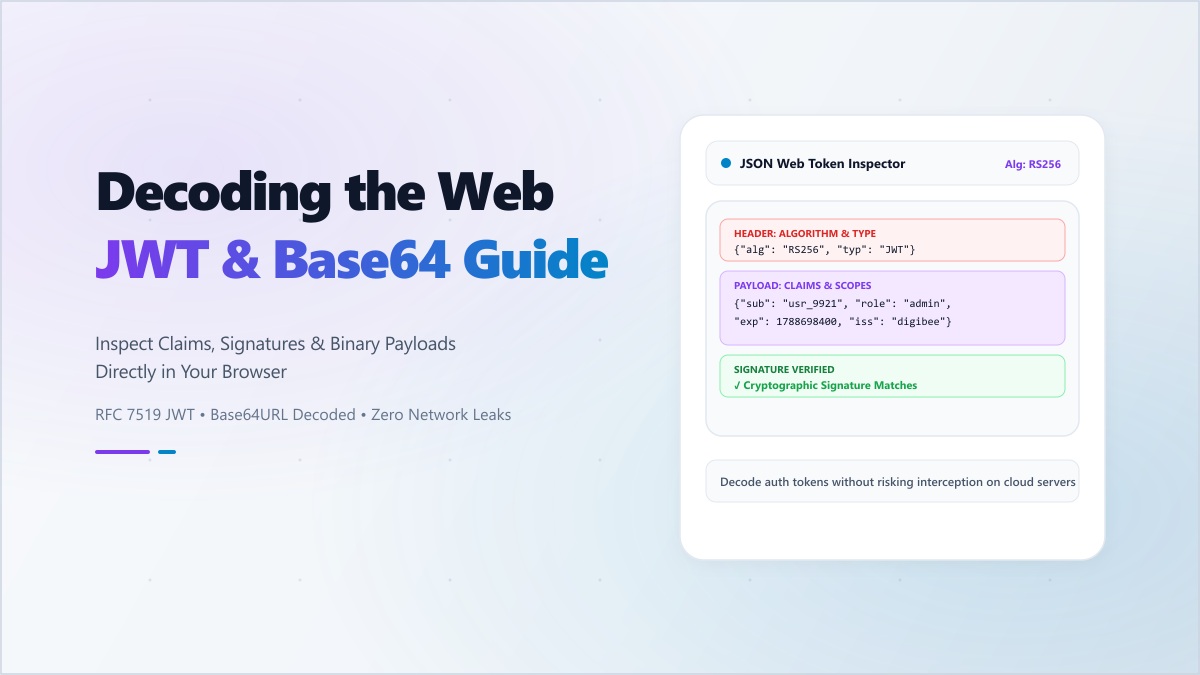
- JWT (JSON Web Tokens): The gold standard for modern authentication. A JWT isn't a secret; it's a signed claim. Decoding a JWT allows you to verify user roles, expiration timestamps, and metadata without needing a database lookup.
- HTML Entities: These ensure that special characters (like '<', '>', or '&') are treated as text rather than code by the browser, preventing your layout from breaking or being vulnerable to XSS attacks.
The Critical Security Gap: Why 'Online' Decoders are Dangerous
If you are troubleshooting a production issue, you should never paste a live JWT or a sensitive Base64-encoded credential into a random online decoding website. If that token is still valid, you have just handed over a "skeleton key" to your application. Most public decoding sites log every input, and if their database is ever leaked, your company's security is compromised.
Digibee: Secure, Local Inspection
Our JWT Decoder, Base64 Converter, and HTML Encoder were built to provide professional-grade inspection without the risk. All processing happens 100% locally in your browser's execution context.
- JWT Inspection: Instantly view the Header, Payload, and Signature structure of any token.
- Base64 to File: Convert encoded strings back into their original binary files (PNG, PDF, etc.) for visual verification.
- Bi-Directional HTML Encoding: Effortlessly switch between raw code and safe-for-web entities.
Troubleshoot with confidence. Keep your tokens, your data, and your users safe by using Digibee's local-only developer tools.